Being a part of the PTM Community

What is the cost to join PTM?

The group is free and all webinars and mentoring are provided free of charge.

What is the purpose of PTM?

The PTM group was created to inspire anyone with a dream to become a pilot. Often the first step is the most difficult - to simply get started.

In the webinars we'll answer questions like:

  • Can you become a pilot after 30? (Hint: Yes, you absolutely can!)
  • Does it cost £120,000 to become a pilot? (Hint: No, it doesn't!)
  • Can you get a job as a pilot without a scholarship? (Hint: Also yes, you can!)

A common belief is that you have to be young and wealthy to become a pilot. This is not true. With hard work, dedication, and the right guidance, anyone can achieve their dream of becoming a pilot.

What does PTM stand for?

PTM stands for Pilot Training Mentoring. It is a group of pilots who are dedicated to helping others achieve their dream of becoming a pilot.

Sign up for our free webinars

Airline Sponsorships

You've been short listed for an airline scheme, what now?

First of all, huge congratulations for getting short‑listed, that is a huge achievement in itself!

Firstly, check the actions to complete right now. Usually it starts with an aptitude test and a behavioural questionnaire. The rest after that is only if you get short‑listed and if it comes to that you can join one of the free webinars!

The key to the questionnaire is not to lie or over‑exaggerate because they tend to ask the same questions many times over. So if you lie, you will forget how you answered that question the first time they asked it, and then the results will look very strange because some will be strongly for whilst other answers say strongly against the same thing!

The questions are generally on a sliding scale too. Let’s say something like:

I dislike working in a team … I am not creative

You often have to pick how you lean. Sometimes the statements don't make sense or don't ‘fit’ together so it can be hard to tell. If that’s the case it might make them easier to compare if you put both statements into a positive sense.

How to do that? So here in my example, they're both negative. In my head I might quickly invert them into the opposites so that they're not negatives anymore. Such as:

I like working alone … I like following set procedures.

Perhaps, for me I agree with both of these statements equally. Except, usually you can’t select a middle option, you have to pick which one you agree with more. If say, I prefer working alone slightly more than I like following procedures I'd go slightly to the left. If I much prefer working alone, I'd go further left and if I really hated following procedures, I'd select the furthest option to the left.

That's the easiest way to describe the behavioural questionnaire.

For the aptitude tests, there are a range of different tests, which you can often easily practice a little bit on some free sites. Additionally, you can also practice each test before you do it for real. Make sure you do the practice tests a few times until you feel really comfortable with what the exercise is, what they are asking you to do in the time allowed and how the difficulty will progress.

In general there are a range of different exercises from maths, to sorting shapes and colours and multi‑tasking. Don’t ever guess the answers and don't make your answers up. They're designed in a way to put the pressure on and to make you feel pressured. The trick is to go at your own pace and to try to get every one right. It's better to be slower and get them all right than be a bit faster and only get 50% right!

How should you prepare for an interview and assessment for a scholarship?

Firstly, well done for getting an interview!

I can only speak from my own experience of being awarded a flying scholarship, which might not necessarily be what other airlines are looking for; but I think a great starting point for anyone about to attend an assessment or interview.

Firstly, for the pilot aptitude assessments there are a number of practice simulation softwares you can download on your computer, along with picking up a second‑hand joystick to practice the different type of assessments. Additionally, there are some really good books with mental arithmetic and quick‑thinking exercises. If you have to commute by public transport these little books are perfect for on the go to get you thinking in the right way about how to approach these exercises.

If your basic school level maths and science is lacking, it would be advisable to use the free BBC bite‑size resources online. They are published in little sections you can use to brush up on basic principles and formulae. The way to test you understand something is to try explaining it to a five‑year‑old.

In terms of interview prep, you should know exactly what the airline does, where they fly, the aircraft they fly and engines they have fitted to them. On top of that, you should know exactly the kind of people they recruit – including their qualifications, skills, aptitude and attitude towards the work they do, the role you would be expected to fulfil, the length and intensity of all the training you would be obliged to complete, the knowledge you would be required to retain and the timeframe to acquire it, the expectations upon you to fulfil the role and the professional standards expected from you upon qualification.

You should read up on recent news articles about the company, their new initiatives (including green and product development), know the company values and strategy, fuel and carbon‑saving initiatives (if applicable), challenges facing the industry, and how you envisage your role as a pilot in the company can help address those challenges. If you find something about the company you’re genuinely interested in or curious to know more, use this as the starting point for your questions.

Go through the role and person specifications and check you have a range of different example situations that you can demonstrate through the STAR model in order to answer competency‑based questions efficiently.

Use this as your starting point, not the end goal. You should basically feel like you are ready to start the job immediately without much additional teaching on the basics. You should be able to answer most of their questions confidently and comfortably without checking your notes, although it’s always good to have your notes in a folder in front of you on the table to give you that confidence boost!

Don’t forget to take along your folder of achievements, including evidence of any volunteering projects, flying logbooks, and perhaps your chart with your last cross‑country flight drawn up if it’s something you’d be confident talking about.

You should wear smart trousers, with shirt and tie (all genders in my opinion as this is expected from all genders on qualifying) and highly polished shoes. Hair should be clean, smart and tied back – it’s an interview not a fashion show.

What if you've put your hopes on a one cadet scheme but didn't get it. Should you do something different before you apply again?

I was modular pilot and probably biased but for young people (under 26 ish) I have to disagree!

Passenger jet flying is a completely different operation to cargo, flight instructing, oil spill observation flying, air med ops, animal welfare surveillance, approach equipment testing, aerial mapping, photography, short range turbo prop passenger flying, parachute dropping, military defence, missile moving, lighthouse inspection, police or any other kind of flying operation.

Are you a gamer? If so imagine having every old & modern game to play since the 70’s, every PlayStation and computer ever built and saying “it’s a shame I can’t skip them and go straight to meta VR.”

Or you drive? Imagine skipping every car you could ever drive with “oh but I want to learn to drive to be able to drive a minibus in cruise control”.

Don't get me wrong when I was younger I also had a dream of getting a sponsor scholarship that would take me straight to the front seat of a passenger aircraft because I didn't really truly know any better about the industry.

I never imagined flying a turbo-prop would be fun. I never imagined that getting experience in multiple areas of aviation would put me in an excellent position; not just for my flying future, but in terms of building resilience. It has ultimately helped me to develop backup plans for a variety of situations that I didn't know then, that would affect me later in life. I didn't know when I was younger that I would have an absolute blast living in a shared house with other cadet pilots also studying, working and flying around the clock. I didn't know that working for a smaller airline where the pilots had a relationship with the operations team (Ops) would be a completely different feel to flying for a much bigger commercial operation.

Most of all, I certainly don't expect to be one day sat in the cruise as an FO beside a captain who had been on my exact university course. I heard everything he had experienced up to that point and suddenly realised that all jealousy I previously had for those with family wealth and therefore access to integrated opportunities would suddenly be put into perspective. It was at this exact moment I was so incredibly grateful for the many wonderful and exciting experiences, the stories, the variety, the lack of any serious debt, the sponsorships along the modular route I was pursuing anyway, both bonded type ratings, the higher salary (often the case when you join an airline direct entry with former experience since you don't owe them for 7 years).

The Airbus is fantastic - very safe, comfortable, clean, quiet and logical (mostly). But it’s also an absolute TREAT after years flying something that needs a lot of rudder, regular failures, dents & holes, trimmed in all axis and sounds like it’s eating itself. After that you will never feel like you’re missing out by not flying much manually.

In my 30’s I love flying the Airbus! But before I started I had an absolute BLAST flying the ATP (manual) as well as flights in Extra 300, Firefly, Jodel, Supercup 180, Bulldog, RV7, Robin, Eurofox, Cessnas, Warriors, Seneca, Seminole, SR22, DA42…

Personal opinion but I think an integrated course is a great place for someone who has varied work experience, flown a few different types & at different airfields.

An integrated course that puts you into a commercial passenger airline will give you the opportunity to mostly operate the aircraft. A smaller turbo-prop operation will give you the opportunity to mostly fly the aircraft.

So many people say “I am in this process/ saving for integrated/ waiting for someone to decide, but I've planning modular in case it doesn't work”.

Modular takes no planning whatsoever. You call a club, book a lesson and go, that’s it. Get a job if you need more money.

For perspective in 2006 I was earning £5.35/hr working up to 92 hours a week, mostly 3 jobs simultaneously. My goal and financial budget was to do at least an hour a month.

Don’t wait to get a place or a scholarship. Hours in your logbook don’t get deleted regardless what you do afterwards.

Join our Linkedin Group

Getting the most from PTM

Who can join PTM?

PTM is open to anyone interested in a career in aviation, regardless of their background or prior flight experience. We welcome aspiring pilots from all walks of life.

For those under the age of 18 we welcome parent or guardian support and guidance. The Safeguarding policy can be found here: Safeguarding Policy

How do I access the mentoring sessions?

Mentoring sessions are announced through our online community channels and email newsletter. Simply register for the sessions you are interested in and join at the scheduled time.

How to get your next big aviation internship/ experience?

If you’re still at school and have never worked in aviation before, or perhaps you’re an aviation undergraduate or have a great job in the industry but trying to get to the next level up…

First off, have a look at the opportunities around you. The opportunities available to a 25yr old with a car and an income differ greatly from those available to a school student on public transport. But a good starting point is to have a look at your local airport or airfield on google maps and make a list of every aviation related firm around the perimeter. Differentiate between charities and businesses. Have a look at the websites for work or volunteer positions currently open. Then after you’ve done your research visit them. A museum, charity or flying club is a good place to get a tea if there are facilities, mingle and chat to a few different people about their experiences there.

A business is a good place to go smart, clean and fresh, neat and tidy hair and with your logbook, folder of achievements and a CV. Greet everyone with a good handshake (ladies, you too should master the art of a firm and polite handshake), treat everyone like they might give you a job and be interested in the work going on. If you go on a Friday be prepared to try a trial shift on a Saturday or to have a spontaneous mini interview about what you could bring to the business, your goals and plans for the future. Be honest about your pilot ambition, you might meet like minded people that support and motivate you along the way.

If you already have a great job working (for example) in ops for an air operator, you might look for an opportunity that gets you mingling with other pilots more regularly or in a flying club where as staff your flight training could be heavily discounted (a great benefit to have!). It also puts you in a position to be able to more easily approach instructors for guidance and support and to meet like minded individuals with great tips and advice, who will likely hold you accountable, and might even support you and join you on your journey - never a bad thing to have!

Join our Discord Channel

The BIG questions

When should you apply to a cadet scheme?

Steph applied for a Cadet Scheme with a cargo airline during the time she was working as a Night Coordinator for an Air Med AOC 8pm‑8am for every 5 nights in 8, in addition to working half‑day weekend shifts as a receptionist for a flying club. This rolling pattern was less than ideal. She survived by meal‑prepping for days in advance, having sets of uniform ironed and lined up ready to go and by making the most of every single minute to sleep around the crazy days. She would also plan annual leave in advance using single days here and there to sleep.

A Night Coordinator working on her own she organised complete ground and air transport for surgical teams, transplant organs and patients. Duties included liaising with local transport coordinators, activating company drivers and arranging meeting‑point handovers, calling pilots from standby, arranging ground‑based services for the aircraft and planning blue‑light urgent transfers. It was here in this role Steph came to understand the term Air Operator Certificate (AOC) and who the companies, or airlines, are who hold them.

She became familiar with the names and voices of those in the industry and years later met many of these pilots. In the flying club she would take bookings, manage the diary, refuel aircraft, launch and liaise with customers. She was actually so low‑paid here that it wouldn’t have been worth driving there for the work, except that she got a phenomenal discount on flying hours and as a trainee pilot that made it a job worth its weight in gold.

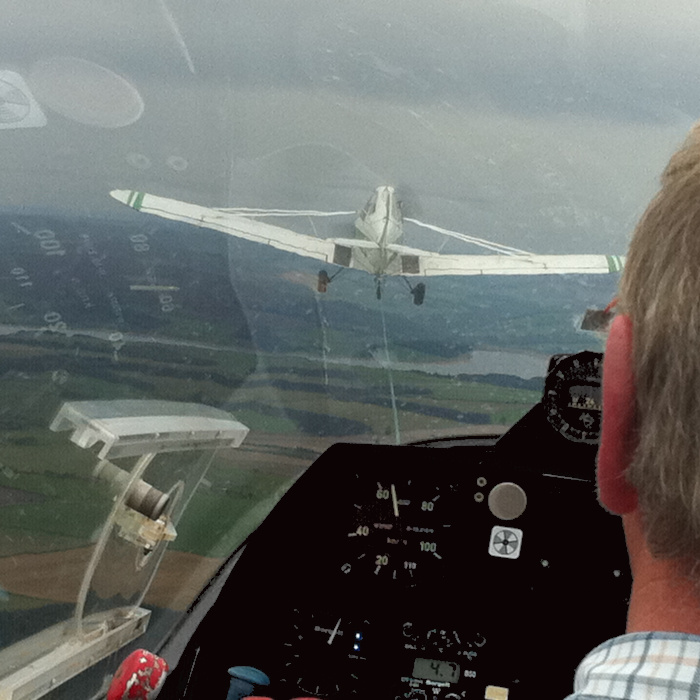
Steph applied to the Cadet Scheme at this time knowing she’d done and was doing everything she possibly could. She was flying as much as she could afford, learning as much as she could, armchair flying whenever she had the chance, volunteering in schools, mentoring and inspiring students across the country, as well as working through the ratings – PPL, night, aerobatics, tailwheel and towing.

She was still gliding too and had bronze, X‑Country and silver height gain. Basically flat out doing absolutely everything she could and she desperately needed the help to get the scholarship. After a few earlier cadet applications years earlier she finally applied for the cadet scheme she really wanted. The scheme would allow her to use already‑learned skills in Ops, then get to fly a really exciting round‑dial turboprop commercially.

How can you get a sponsored cadet scheme?

Steph was offered an interview for a sponsored cadet pilot scheme (a cadet that works for the company whilst hour building and completing the theory exams before the company would fully fund the CPL ME IR MCC TR*). However, the only way she could make it to the interview was after a 12‑hour night shift, half‑day shift, 5‑hour sleep, another night shift then shower, change and then a 4‑hour drive to Coventry from Darlington.

She arrived at the hotel room and ironed her shirt before the interview mid‑afternoon, exhausted and not sure how she’d survive the day through to the early hours.

After the technical interviews, we were taken by the cadets to a simulator where it was agreed we'd draw straws to decide who was next. The sim was a circuit in a 737. After 4 people had flown I asked the instructor if I could go next. I was so sleep‑deprived already and could stay awake much later. Fortunately the group took pity on my night shifts and I was next, running on empty and close to collapse. Little did I realise then, but learnt later on the day of my base training, that I'd done a good job in the sim. The instructor was also impressed that despite everything I’d saved plates of food from the buffet for the two instructors and also cleaned and put away the dishes at the end, which they would have otherwise had to do.

My interview prep beforehand involved brushing up all on my PPL theory, memorising some common conversions, learning all the GCSE‑level formulae, brushing up from the Pilot Operating Handbook of the aircraft I was currently and had previously flown (including gliders) and reading everything I possibly could about the Lockheed Electra and BAe ATP (their two cadet entry aircraft).

My preparation didn’t just take hours but weeks of making lists of things to study and carefully working through the list.

I had a few books with formulas, my original PPL study books were annotated and highlighted to death. I looked up the company financial documents on the website and learned a little about the costs that the company would incur for my training.

*Commercial Pilot Licence, Instrument Rating, Multi‑Engine, Multi‑Crew Cooperation and a specific aircraft Type Rating.

You’re young, logged hours, but no savings – should you keep going?

Let’s say you’re 17, hours logged around 10, expecting decent high‑school qualifications, but feel like the money you have saved will soon run out and your progress might decline in the long run. I was exactly this person 20 years ago.

Firstly, try out the budget calculator on the home page! If you don’t have secured finance, this needs to be a plan for the long game, not a short injection of cash with huge breaks in between!

Steph had a little black notebook which became her bible. She noted every scholarship, cost to attend, how many years it had been running for, as well as typical age, flying hours, qualifications and standout attributes of the former winners. She also checked every degree course she applied to, the flying qualifications she would achieve as part of that course, the cost and where the gliding club was for each of those universities.

In the beginning Steph applied for any and every scholarship and wasted a lot of money to be told the same thing – she wasn’t in the top few percent for the aptitude tests. She was annoyed that she'd spent so much flying money on so many aptitude tests and scholarship shortlists, especially dry cleaning and train tickets! (Hint to airlines – a 30‑min loggable check flight in the sim as an aptitude test would make genuine pilots very happy!)

Hint – the guy who dropped out of my uni course early and the guy who failed the final exams are both flying as successful captains with reputable airlines. Fortunately a few of the aptitude test centres gave me really good feedback with actionable points to work on. So I added those points to my book and began creating a plan to improve myself in those areas, and to be a better applicant for the next one.

The best way to get experience in a wide range of disciplines is to do volunteering in an area you’ve never worked before and to challenge yourself. Volunteering organisations are usually very happy to let young people get involved, especially when they have the initiative to make reasonably wise and mature decisions.

Steph documented each stint of volunteering, eventually logging hundreds of hours across many organisations. This also became a blessing in interviews as she had many different experiences and challenges to talk about. She promised herself she would only apply for a scholarship if she was quietly confident of making it to the end.

See the step by step guide